Who She Is
Deepta Belagur had a comfortable childhood rooted in strong family values. And the community outside her home played an equally vital role in shaping her outlook and character. In her hometown, Rayadurga, Andhra Pradesh, she often played with the children of the textile mill workers. She discovered early on how fulfilling it felt to include and treat everyone equally. The simple joy of connection stayed with her.
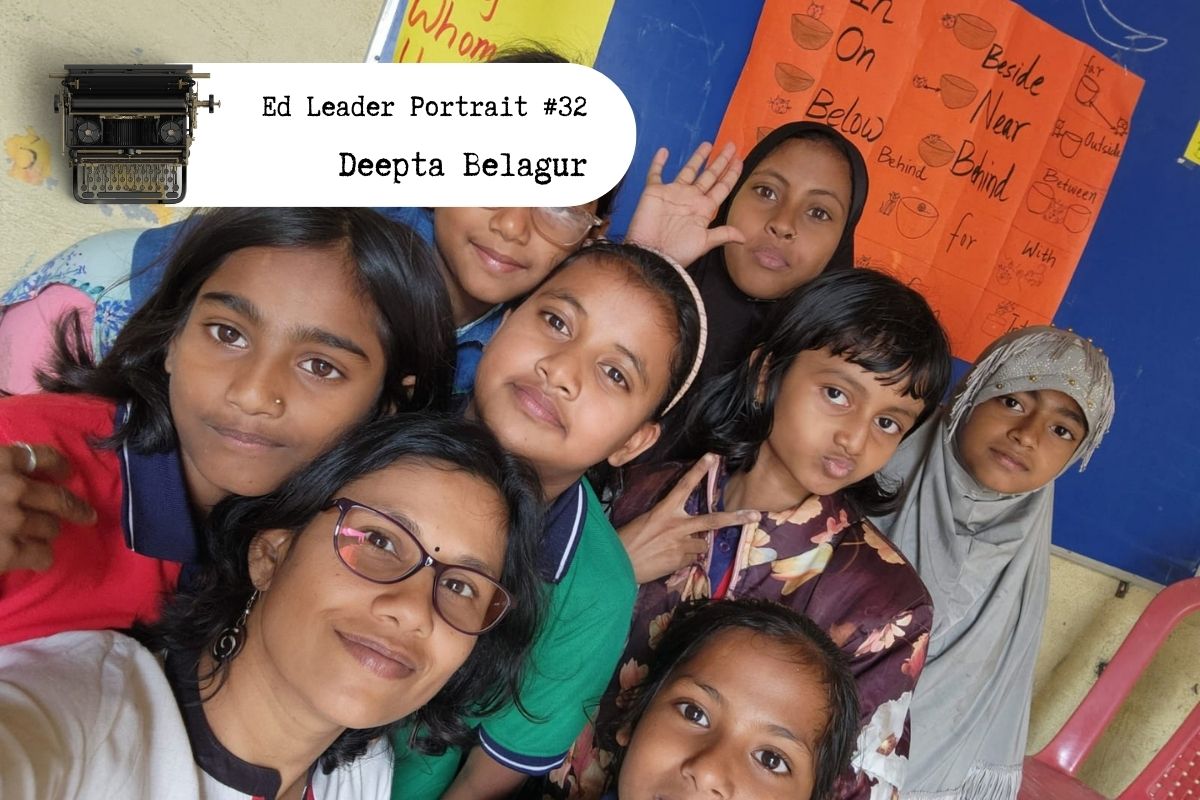
Her teaching journey started in college, when she tutored children in her neighbourhood for free. During the pandemic, she volunteered with Teach For India at their Bridge Programme – an initiative designed to address learning loss. At the same time, she noticed that the children of the domestic helpers in her society had also lost access to education due to school closures. She began teaching six of them at her house, starting with the basics, as they were not at the expected grade level.
She used household materials to make learning hands-on and relatable. She encouraged mindfulness, healthy routines, and involved parents to create a supportive home environment. She managed it all without any formal teacher training. Over the years, the children reached the appropriate grade levels and were successfully reintegrated into mainstream schools—restoring their confidence and rekindling their love for learning.
This experience revealed her true calling: to make quality and equitable education accessible to every child, regardless of background. To further build an understanding of learning practices, she joined the Gubbachi Learning Community, an education non-profit. There, as a volunteer teacher, she helped students on different learning levels to regain confidence and catch up with their peers.
Currently, Deepta is pursuing a Diploma in Teaching and Learning Practices and dreams of founding her own NGO — one that bridges educational gaps and empowers children to realise their full potential.

The Problem She Saw
Throughout her work, Deepta supported children labelled as ‘difficult’ – students facing learning or behavioural challenges. She noticed that many children from less privileged families have the ability to learn but lack equal opportunities. With weak foundational skills and little individual attention in classrooms, they struggled to keep pace and gradually lost confidence. Without the right learning support, these children found it hard to catch up with their peers, missing out on the chance to reach their full potential and aspirations.
The Micro-Improvement Journey
Deepta led with empathy. She believes that meaningful learning happens when children are engaged, curious and supported both inside and beyond the classroom. Her approach focuses on small, consistent steps that build confidence, understanding and long-term love for learning.
- Understanding learners: She began by engaging with teachers and parents to understand both the curriculum expectations and each child’s current learning level. Through one-on-one assessments, she identified individual strengths and areas for improvement.
- Designing customised learning materials: Based on the insights, she curated simple, level-based worksheets and resources, ensuring that every learner could access materials suited to their needs.
- Introducing creative and hands-on learning: To make learning relevant, she turned to everyday household materials — paper plates became clocks, rajma grains demonstrated place value, and chapatis explained fractions. She designed engaging activities to spark curiosity and keep children active, blending academics with joy and movement.
- Differentiated teaching: She developed bridge-learning materials and introduced differentiated instruction techniques. She integrated visual and auditory tools such as educational videos and learning apps like Khan Academy, Byju’s, and Vedantu to enhance understanding.
- Engaging parents: She actively shared videos and worksheets with parents to extend learning at home. She guided them to create simple daily timetables and consistent routines, to build positive and structured learning environments.
- Building awareness and life skills: She emphasised the value of education and its long-term impact on a child’s life. She introduced basic mindfulness routines — breathing, stretching, and meditation exercises — to improve focus and emotional balance.
- Preparing Students for Formal Schooling: As students progressed, she assessed their readiness to transition into mainstream schools. She guided families in selecting appropriate schools based on children’s learning levels and affordability. She went a step further — assisting with admissions and even contributing financially when needed, ensuring no child was left behind.
Role of Civil Society & Support Systems
As a Teach For India Volunteer, Deepta gained first-hand experience of how structured education initiatives operate. She learned about curriculum design, teaching methodologies, student management, and the challenges that children from underprivileged backgrounds face in their learning journey. At Gubbachi, Deepta observed the importance of tailored learning materials and differentiated teaching for children with diverse learning styles and backgrounds.
Why She Went Beyond
Deepta discovered her deepest fulfilment in bringing happiness and making a meaningful
difference in others’ lives. She has always sought to be of service, believing that her
existence carries a purpose. From an early age, she dreamt of an equal society. Through her initial experiences in teaching, she realised that providing children with quality education is the foundation for a stronger, more equitable society — and ultimately, a better future for the country.

The Impact Her Work Is Creating
Deepta’s empathetic and hands-on approach has transformed the learning journeys of sixteen children who had fallen behind —from the children of domestic helpers to marginalised learners at Gubbachi.
Through her patient and creative methods, these children not only caught up academically
but also regained the confidence to rejoin mainstream classrooms — a transformation reflecting both intellectual and emotional growth.
Her Words
“I am inspired by the idea that when a child is educated, the lives of their entire family and their future generations are transformed. Education not only gives a child the means to live, but also gives meaning to life. I am more than happy to contribute to any extent if that can benefit a life.”

This story is part of ‘Small Steps to Build Great Schools’ Vol II– a Coffee-table Book celebrating the leaders who go beyond their roles to make education inclusive, joyful, and rooted in belonging, for children in India.
🔗 Read more such stories of transformation here: https://heyzine.com/flip-book/d4afa18256.html


 Link copied to clipboard!