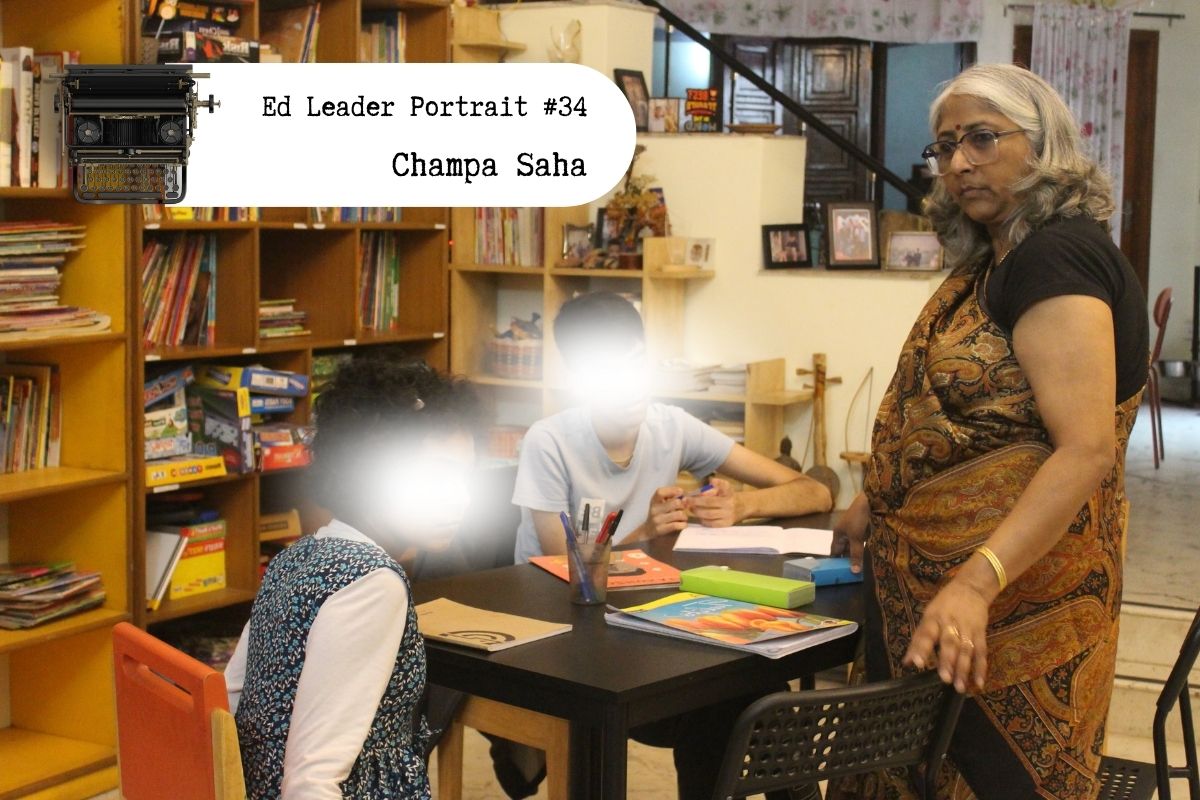
Who She Is
Champa Saha’s journey as an educator began not in a carefully designed inclusive classroom, but in one that exposed the system’s limitations. After pursuing a B.Ed., her first posting in the late 1980s coincided with India’s earliest experiment in inclusive education — the Project Integrated Education for Disabled (PIED).
“I walked into a classroom with three or four learners clearly different from the rest,” she recalls. “I felt completely inadequate.” Instead of keeping her distance, Champa chose to understand them — reading extensively, speaking to doctors, and observing her students closely.
Those years became her real education. Terms like “cerebral palsy” and “intellectual disability”
became familiar, though autism was rarely discussed then. One student with severe cerebral palsy had extreme difficulty controlling her hand movements. She longed to write but struggled with the fine motor control needed for regular paper and pencils. When Champa gave her large sheets of drawing paper, for the first time, Jaspreet could move her hands freely and trace letters. This moment shaped Champa’s belief in small improvements to unlock a child’s potential.
Then in 1994, her second child Ankush’s difficult delivery turned her professional journey into a personal one. Doctors predicted he would never read or sit up, but Champa refused to accept that ceiling. She adapted her teaching methods at home, nurturing his abilities. Today, Ankush has defied those predictions — winning a silver medal at the 2019 Special Olympics World Summer Games.
After two decades in school, Champa decided to work independently, mentoring parents and teachers of children with learning difficulties. In 2020, she founded Mayakunj Education Trust in Bengaluru — an inclusive learning space. What began as a pre-primary initiative soon evolved into a home-school for learners with diverse needs. “Mayakunj was never meant to be a crutch, but a stepping stone to discover possibilities”, she says.
The Problem She Saw
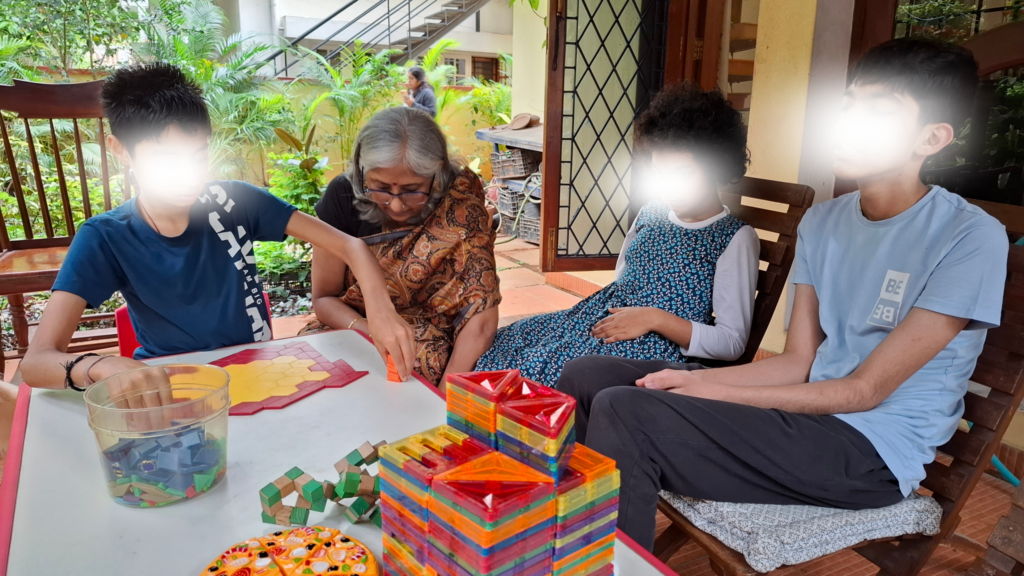
Champa noticed that most parents of atypical learners came seeking “rectification.” “Almost all parents want atypical minds to be normalised,” she explains. Over time, she realised the deeper issue wasn’t just awareness — it was the system itself, designed only for adult convenience rather than child comfort. “Anything neurodevelopmental is not a disease to be cured. When the primary goal is to make a child fit the existing norms, we’ve already lost the battle. If a three-year-old says they are hungry, we ask them to wait till the bell rings. That’s where self-awareness gets curbed. We’ve built systems that suppress, instead of nurturing it.”
The Micro-Improvement Journey
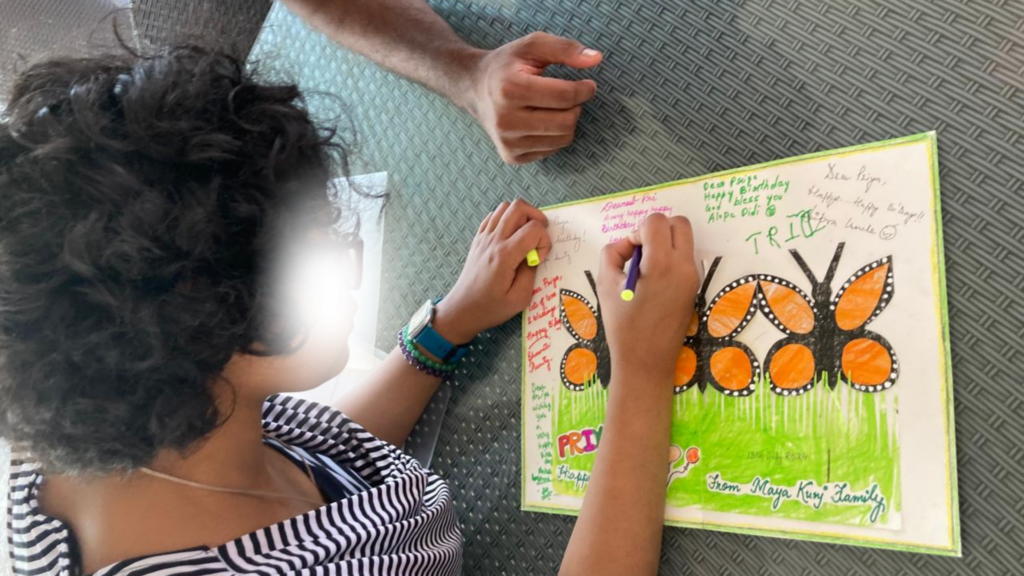
At Mayakunj, Champa redefined learning by placing students’ mental and emotional comfort before curriculum. She believes that no learning can happen if a child is hungry, tired, or anxious. “If a child hasn’t slept well or comes to class hungry, the brain isn’t ready to learn,” she explains. “It’s the same for all children — only, for those with neurodevelopmental differences, these needs are heightened or varied. They are not in any sense irrational.”
She builds learning experiences around each child’s individuality. For instance, Ivan, who is non-speaking and autistic, loves buildings and structures. One day, while stacking toys into a tower, Champa watched it fall and explained that it toppled because the base wasn’t wide enough. Ivan listened, then built a sturdier tower himself — learning balance and proportion through play.
- Individualised learning plans: Every child learns at their own pace through methods tailored to their sensory, emotional, and cognitive profiles. There are no fixed timetables or uniform goals; instead, learning pathways evolve through continuous observation and dialogue with the child. Each plan integrates cognitive goals (reading, writing), socio-emotional growth (self-expression, managing anxiety), and daily living skills (self-care, navigation, and communication).
- Comfort of mind before curriculum: Champa begins each session by ensuring children feel safe and regulated. Lessons may start with storytelling, music, or sensory play — depending on what helps each learner settle. “Only when the mind is at ease can real learning happen,” she says. This emphasis on emotional readiness reduces performance-driven pressure with self-assurance.
- Everyday life skills as curriculum: From dressing themselves and pouring water to making small financial transactions during field trips, learners practice decision-making and self-reliance daily. One student with hydrocephalus (a condition in which fluid builds up within the brain, leading to pressure and developmental challenges), once told he’d never manage self-care, now drinks water and uses the washroom independently — milestones that restored his confidence and dignity.
- Feedback that builds awareness: Instead of generic praise, Champa uses specific, descriptive feedback that helps children recognise progress. “Rather than writing ‘good work’ or ‘beautiful handwriting,’ I note what’s gone well — ‘letters are legible, evenly spaced, and clear.’ It helps them see why it’s good, and that awareness motivates them more than praise ever could.”
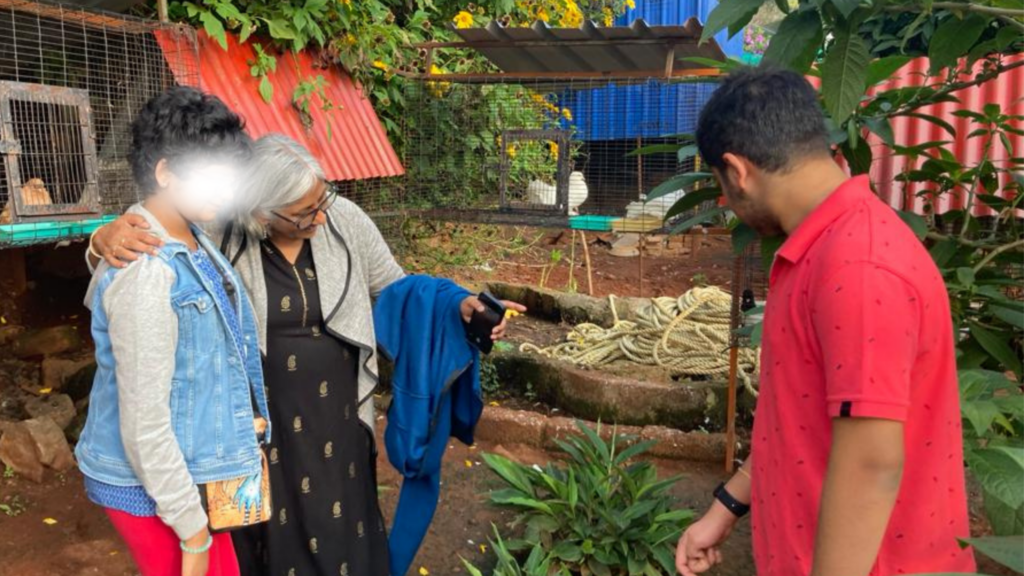
- Community learning beyond the classroom: Weekly outings to museums, bird sanctuaries, and restaurants allow children to practice social interaction, sensory regulation, and curiosity outside the classroom. Field experiences are followed by reflection circles where children share what they observed or felt, reinforcing self-expression and awareness.
Why She Went Beyond
Champa’s lifelong conviction is that education should nurture self-awareness, not conformity. “We’ve built systems where children mask themselves just to fit in,” she says. “My work is to make sure they never have to.”
“If a learner doesn’t sit still or respond to general instruction, that doesn’t make them a non-learner,” she explains. “When I celebrate a child simply holding a pencil, some may see it as trivial. But for that child, it means the world — tomorrow she will go on to feed herself, dress herself, live with dignity.”
Champa believes that the role of teachers is not to fit children into exams, but to help them discover who they are. “The true purpose of education is self-awareness,” she says. “Everything else follows from that.”
Impact Her Work Is Creating
Since 2021, 18 children have found a learning path through Mayakunj. Many of them were once told they would never speak, read, or learn independently. Two of her alumni, once considered “non-readers,” completed their Grade 10 through the National Institute of Open Schooling (NIOS) and now study in mainstream schools. One of them, Niranjna Eyyala, born with mild cerebral palsy, is now a student leader at Bethany High in Bengaluru and recently won a school debate competition.
Each learner’s growth — from decision-making to choosing their own books on reading trips — reflects the impact of an environment built on trust and belief, not correction.
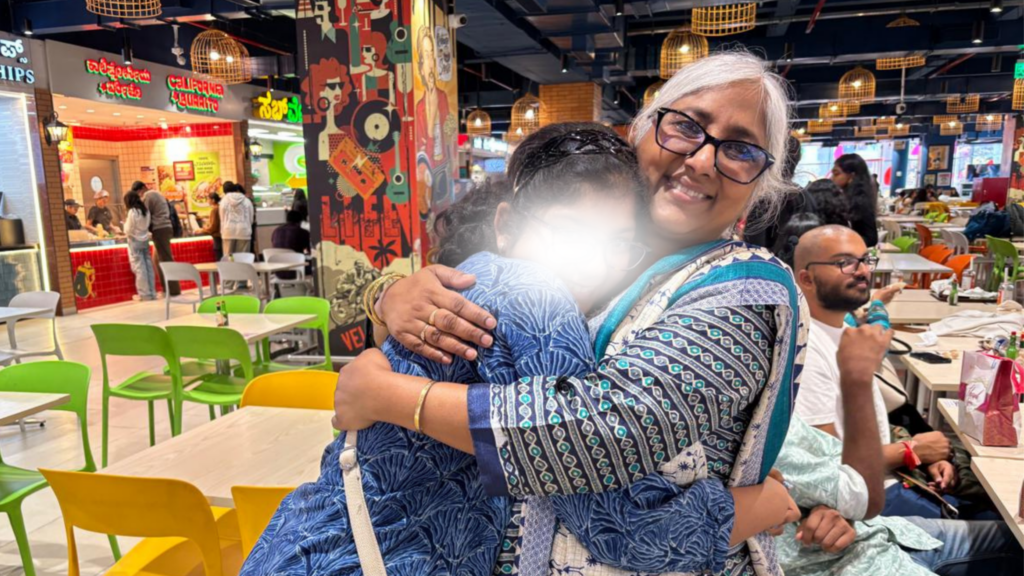
Her Words
“We need a complete rethinking of how teachers are trained and how learning is defined. Today, teacher education is scattered — millions of authorities, countless certifications, but no common foundation of quality or compassion. Every teacher, no matter their subject, should have basic knowledge of working with learners who see, hear, move, or communicate differently. Just like in medicine, where every doctor first learns about the whole human body before specialising, every teacher should first learn about the full spectrum of learners.”
This story is part of ‘Small Steps to Build Great Schools’ Vol II- a Coffee-table Book celebrating the leaders who go beyond their roles to make education inclusive, joyful, and rooted in belonging, for children in India.


 Link copied to clipboard!